




Cosmetic Dentistry in Mukilteo: Beyond Veneers and Whitening
· By Wholistic Dental Care · 14 min read
A 5-star rating from 88 reviews puts a heavy burden on anyone thinking about a smile change, because cosmetic dentistry starts with the person, not the procedure. A new front tooth shape, a brighter shade, or a fixed chip sits right where people look when you talk. If the choice gets rushed, the bill is only part of the cost. The trouble is that many cosmetic options look alike online. Search for dental veneers near me or teeth whitening near me, and you get polished before-and-after photos. That photo does not tell you which material touched the tooth, whether the bite was checked, or how the plan handled sensitivity, old metal, anxiety, or a child who needs a gentler first visit.
Cosmetic dentistry in Mukilteo should begin with a different question: what changes the smile while disturbing the body the least? Veneers and whitening still belong in the discussion, but they should not carry the whole load when the patient cares about biocompatibility, fluoride exposure, BPA, mercury, metals, and the nervous system response to dental work.
What should a cosmetic dentist in Mukilteo, WA check before changing the smile?
The first cosmetic choice should be whether the tooth, gum, bite, and material plan are ready for a visible change. Shade and symmetry matter, but a smile makeover near me search does not show whether an old filling is leaking, whether tooth wear comes from clenching, or whether a whiter shade will make older restorations look mismatched. A biological cosmetic exam treats the mouth as part of a larger system, not as a display case for new surfaces. Health comes first, compatibility second, appearance third. A beautiful restoration that irritates tissue or fails early has not solved the patient's problem.
Wholistic Dental Care in Mukilteo is a biological/holistic dental practice that treats the whole body, not just the mouth, using biocompatibility testing, metal/fluoride/BPA-free materials, and energy/emotional work. That stance changes the cosmetic talk from picking a shade to choosing the least disruptive path to a smile the patient can live with. A detailed first visit should sort out which cosmetic complaints are structural, inflammatory, or tied to materials. A gray tooth beside old metal, a rough edge that keeps chipping, or stains around aging fillings needs a different plan from healthy enamel that is simply darker than the patient wants.
CBCT 3D imaging & low-radiation digital x-rays belong in the planning stage when the dentist needs more than a surface view. Imaging does not make every cosmetic case complex, but it does help separate a simple enamel change from a tooth that needs a deeper diagnosis before any whitening, bonding, or veneer discussion begins.
A family looking for a natural approach for children should ask the same question in smaller form: what is the least intervention that protects the tooth and keeps the child calm? Cosmetic concerns in children are usually chips, discoloration, developmental enamel differences, or anxiety about being seen, so a gentle exam matters before anyone starts talking about appearance.
Veneers, bonding, crowns, and whitening are different jobs
Cosmetic bonding offers a conservative path when a tooth needs local reshaping instead of full-coverage work. Resin goes directly onto a chipped corner, worn edge, or uneven spot. The real trade-off comes down to future upkeep, since composite takes well to repairs but still picks up wear over the years.
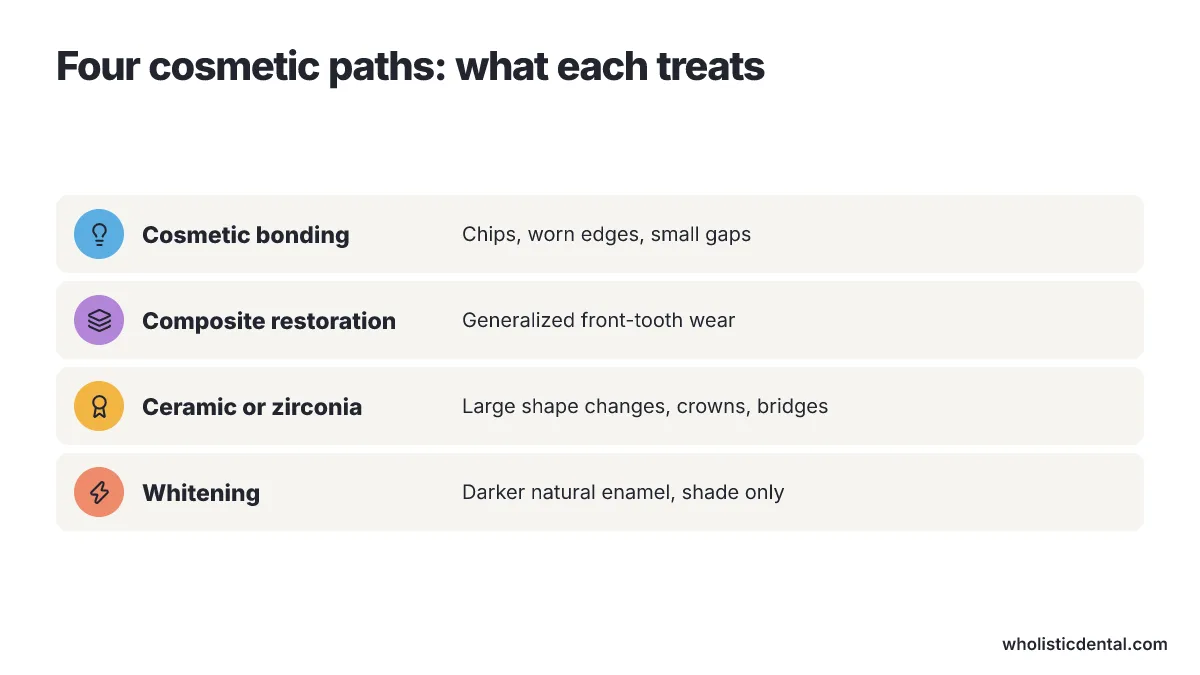
Composite is a sturdy choice on paper, not a stopgap measure. A 2024 European Journal of Prosthodontics and Restorative Dentistry review calculated 88% survival for composite resins used across front-tooth wear through 2 to 10 years, though individual studies showed quite different outcomes. Patients look at those numbers and should immediately ask how their clinician manages bite pressure, repolishing routines, and future patch-ups. A separate 2024 British Dental Journal paper found anterior composite restorations hit a a median survival time of 5.9 years once the team tallied every kind of failure. That lower median survival simply brings planned checkups and routine maintenance into the early consent talks.
Veneers and crowns sit on another shelf entirely because they take away natural enamel and force bigger choices about ceramics.
Anyone hoping for uniform shade and matching contours across visible smile lines needs to weigh their options before shaving down healthy tooth material. Can modest bonding protect the tooth surface, does partial coverage handle the strain, or does the underlying tooth genuinely need a full crown?
Whitening modifies color without grinding away enamel, though treating sensitive teeth calls for diagnostic planning instead of extra-strength peroxide. Dentists need to inspect root exposures, fracture lines, thin enamel, and old restorations before starting, because bleaching lightens natural tooth tissue while leaving old synthetic resin and porcelain the exact color they were.
| Cosmetic option | Best fit | Main trade-off | Evidence or planning question |
|---|---|---|---|
| Cosmetic bonding | Chips, small gaps, worn edges, and conservative reshaping | Composite preserves tooth structure but needs polishing, repair, and bite checks over time | The 2024 European review reported 88% survival for composite in front-tooth wear cases over 2 to 10 years |
| Broader anterior composite work | Generalized front-tooth wear where repairability matters | More surfaces mean more maintenance decisions | The 2024 British Dental Journal study reported 5.9 years median survival when all failure types were counted |
| Ceramic or zirconia restorations | Larger shape changes, crowns, inlays, onlays, or bridges | Strength and appearance come with bigger preparation and material choices | A 2024 Journal of Esthetic and Restorative Dentistry review found zirconia and alumina bridges durable in studies with follow-up of up to 10 and 15 years |
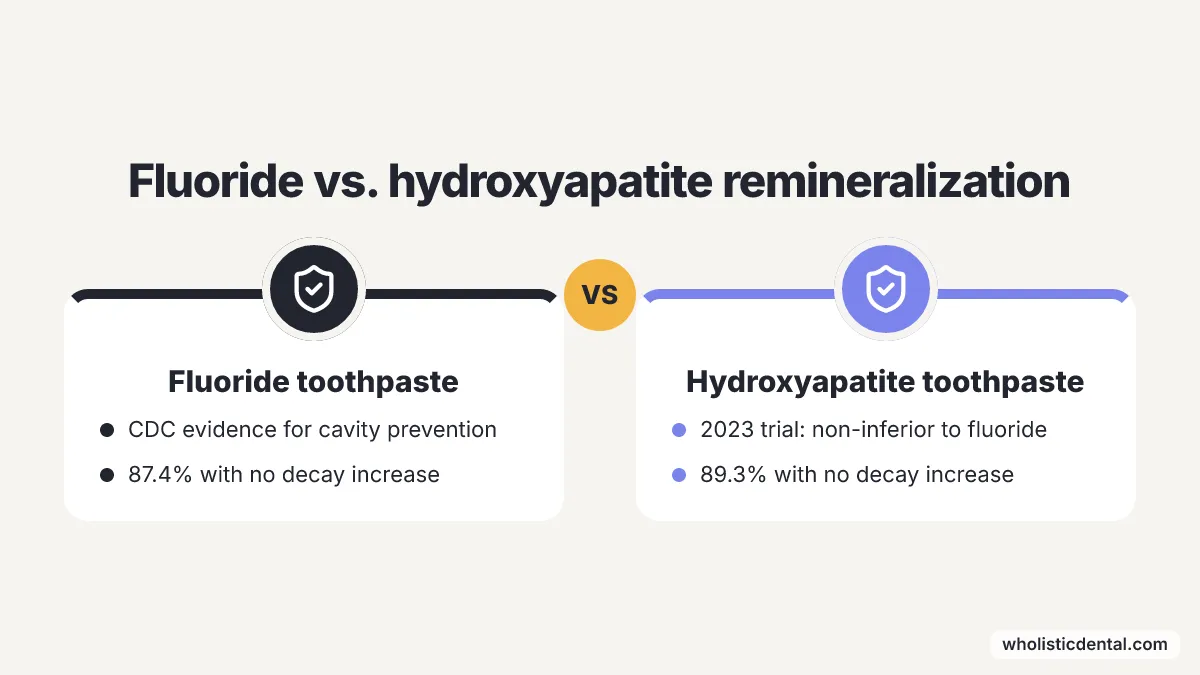
| Whitening and remineralization planning | Darker natural enamel before shape changes | Existing fillings, crowns, and veneers do not whiten like enamel | A 2023 Frontiers in Public Health trial found hydroxyapatite met non-inferiority to fluoride toothpaste for the study's adult decay measure |
Work backwards from the least invasive step: bleach teeth early if shade is the lone complaint, build contour with resin when chipped shape causes trouble, and keep ceramic crowns or veneers for structural breakdowns that justify tooth prep. People walking in asking for veneers might end up picking them anyway, yet the clinical chair is where they first review less aggressive paths.
Why material choice matters more than the shade tab
The shade tab is only one piece of a cosmetic restoration, because the material lives in the mouth every hour after the appointment. In Mukilteo and the Greater Seattle area, people who care about their health often ask a harder question than whether the filling looks natural. They want to know whether the restoration suits their biology.
Biocompatibility blood testing through Biocomp Labs turns a generic material preference into a conversation about a specific patient. Someone worried about metals, BPA, fluoride, or past reactions should not have to pick between looking good and asking what the material contains. Biocompatible and metal-free restorations matter most when old silver-colored fillings change how the smile looks. SMART mercury amalgam removal adds a separate safety-oriented protocol when a cosmetic plan includes replacing old amalgam, so mercury exposure is not treated like a side note to a whiter smile.
New restorative materials keep widening the cosmetic menu, but newer does not automatically mean right for every patient. In April 2026, Ultradent unveiled FORMA S zirconia nano-hybrid composite, with multiple shades for dentists matching tooth-colored restorations to a patient's smile.
Dandy introduced Polychromatic Shade in July 2026, using robotic staining for zirconia restorations to create natural-looking crowns and bridges. A patient considering a zirconia crown should ask whether the dentist's material choice is driven by strength, appearance, compatibility, or the laboratory workflow.
SprintRay launched Midas Restore in the United States in September 2026, a ceramic- and zirconia-filled resin designed for crowns, inlays, and onlays that participating practices can produce in one visit. Same-visit production is appealing when time matters, but a biological patient still needs the same material screening and fit discussion before speed becomes the deciding factor. Cargus announced MARK3 Chroma Chameleon in September 2026, a single-shade composite designed to blend with surrounding teeth. Single-shade systems can make matching simpler in selected restorations, but the patient should still ask how the material performs in the exact tooth, bite, and moisture conditions being treated.
Fluoride-free, nano-hydroxyapatite remineralization is another material choice, not just a philosophy. The CDC states that fluoride helps prevent cavities in children and adults, while a 2023 Frontiers in Public Health adult trial found that 89.3% using hydroxyapatite toothpaste and 87.4% using fluoride toothpaste had no increase in the study's decay index over 18 months.
The honest position is that biological cosmetic dentistry should not pretend conventional materials have no evidence, and conventional dentistry should not dismiss a patient's material concerns as cosmetic preferences. The better standard is individualized consent: name the material, name the alternatives, and choose the option that fits the tooth and the person.
Where do PRF and laser skin rejuvenation fit with a smile plan?
The shape around the teeth changes how a smile reads. Lips, facial volume, skin texture, and the way tension sits around the mouth all affect the result. That is why some people searching for a natural face rejuvenation dentist near Mukilteo are not really asking for veneers. PRF facial aesthetics and laser skin rejuvenation can sit beside cosmetic dentistry when a patient wants a natural-looking facial refresh rather than a change that touches only the teeth. The question is whether the concern starts with tooth color and shape, with the soft tissue around the smile, or with both at once.
Someone looking for laser skin rejuvenation and PRF facial aesthetics in the Seattle area is usually trying to avoid an overdone look. PRF uses the patient's own blood-derived material in aesthetic care. Laser skin rejuvenation focuses on the skin surface. The talk should stay tied to goals, comfort, and medical fit. Dental training gives the mouth and face a shared context, but facial aesthetics should not be used to sell a larger smile makeover than the patient asked for. A careful plan might begin with a chipped edge, irritated tissue, or discoloration before any facial aesthetic service enters the conversation.
Emotional and energetic work also affects how a cosmetic plan feels to the patient. Someone who has put off dental care after motherhood, illness, or a hard dental history may need a slower path, where the first win is feeling safe in the chair rather than leaving with the brightest shade possible.
How should anxious adults and kids start?
An anxious patient should begin with a visit that separates information gathering from treatment that cannot be undone. Dental anxiety changes the body's response to even routine care, so a trauma-informed cosmetic plan should explain what will happen, what can wait, and where the patient has control.
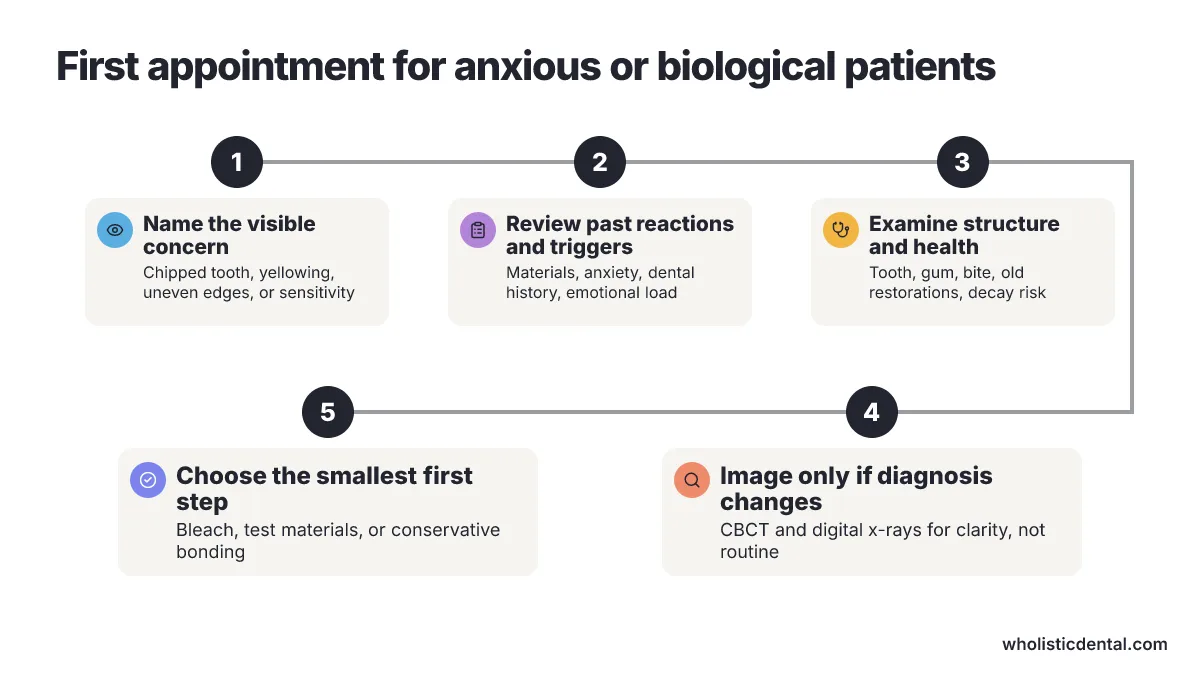
A practical first appointment can be organized in a clear sequence:
- Name the visible concern in plain language, such as a chipped front tooth, yellowing, old metal showing through, uneven edges, or sensitivity after whitening.
- Review past dental reactions, material concerns, anxiety triggers, and any history that makes treatment feel emotionally loaded.
- Examine tooth structure, gum health, bite wear, old restorations, and decay risk before choosing a cosmetic procedure.
- Use CBCT 3D imaging and low-radiation digital x-rays only where the extra view changes diagnosis or planning.
- Discuss biocompatibility blood testing, metal-free materials, ozone therapy, or remineralization support when those choices match the patient's risk and goals.
- Choose the smallest first step that makes the next decision clearer.
Start with a gentle first visit
Book a consultation with Dr. Short at Wholistic Dental Care. We'll check your teeth, gums, bite and material concerns before suggesting any cosmetic change.
Book a consultation · Call (425) 599-5475
315 Lincoln Ave, Building D1, Mukilteo, WA 98275
Families seeking a natural dental checkup for children should ask how the visit will be paced before asking what treatment is possible. Children often need trust, explanation, and a low-pressure exam first. A child who feels safe is easier to evaluate accurately. Ozone therapy fits some biological dental plans as an added conversation, not as a replacement for diagnosis. A patient should ask what problem the ozone is being used for, how success will be measured, and what conventional treatment would be recommended if the tooth does not respond.
Muscle testing or wholistic kinesiology-guided treatment planning belongs in the same category of individualized decision support. A patient who values mind-body care may find that it gives language to stress, tolerance, and material preference. The final dental plan still needs clinical findings that can be explained in ordinary terms.
A patient whose only goal is the fastest possible brightening for a fixed public event should not start with a full biological smile redesign. A limited whitening discussion or a temporary cosmetic repair is the cleaner choice when timing, not long-term material planning, is the main need.
How do you choose the first cosmetic step without over-treating?
Pick the first move that answers the biggest unknown while changing the teeth as little as possible. If color is the question, begin with whitening and a plan for remineralization. If shape is the issue, start with diagnostic bonding or a conservative talk about composite.
If the concern is material tolerance, test compatibility before any restoration is chosen. A patient comparing teeth whitening near me results should ask whether sensitivity will be handled before treatment starts, while it is happening, and after it ends. Old fillings, crowns, veneers, recession, and enamel defects change the whitening plan, because those surfaces do not react like natural enamel.
A patient comparing dental veneers near me results should ask how much tooth structure will be changed. Veneers can look excellent, but restraint should guide the plan. A tooth should not be covered unless the appearance goal, the tooth itself, and the material choice justify the preparation. A patient interested in cosmetic bonding should ask how the restoration will be cared for over time. Composite repair is part of its appeal, but the dentist should talk through polishing intervals, stain risk, edge chipping, and the bite pattern that caused the damage in the first place.
A patient planning a larger smile makeover near me should ask for a staged plan instead of one sudden leap. Staging gives the patient room to test shade, shape, comfort, and emotional readiness before every visible tooth is committed to the same irreversible choice. The most useful consultation question is plain: what would you do first if the aim were to keep as much healthy tooth as possible? A dentist who can answer with a clear sequence is offering something more useful than a cosmetic menu.
Conclusion
Start with a full exam, not a request for a procedure. Bring the cosmetic goal, the material concerns, the sensitivity history, and any anxiety triggers into the first conversation, so the plan begins with the whole person in view.
A good next move is to book a full exam and ask for the smallest step that points to the safest path forward. Cosmetic dentistry can change how a smile looks, but treatment should stop at the point where appearance starts to cost too much healthy structure, comfort, or personal trust. The right plan needs diagnosis, material choice, and pacing, not pressure.
Ready to plan your smile the least invasive way?
Frequently Asked Questions
How do I choose a cosmetic dentist in Mukilteo, WA?
A useful starting point is whether the dentist checks your teeth, gums, bite, and materials before choosing a visible change. The article describes Wholistic Dental Care in Mukilteo as a biological/holistic practice that considers the whole body, uses biocompatibility testing and metal-, fluoride-, and BPA-free materials, and includes energy/emotional work. Ask how the plan addresses old restorations, wear, sensitivity, and the least disruptive option.
Is cosmetic bonding a good alternative to veneers for chips?
Bonding may suit a chip or worn edge when local reshaping is enough; resin is placed directly on the affected area and preserves more tooth structure than a veneer or crown. It can be repaired, but composite may wear over time and needs polishing, repair, and bite checks. Veneers involve removing natural enamel, so the article recommends considering less invasive paths first.
Can teeth whitening change the color of fillings or crowns?
Whitening changes the color of natural tooth tissue, but existing fillings, crowns, and veneers do not lighten like enamel. That can leave older restorations looking mismatched after bleaching. The article also says sensitive teeth need diagnostic planning: a dentist should inspect root exposures, fracture lines, thin enamel, and old restorations before whitening. If shade is the only complaint, the article suggests whitening before changing tooth shape.
What should I ask about materials for cosmetic dentistry in Mukilteo?
Ask what a restoration contains and whether it suits your biology, especially if you are concerned about metals, BPA, fluoride, or past reactions. The article describes biocompatibility blood testing through Biocomp Labs as a way to guide material choices for an individual patient. If a plan includes replacing old amalgam, ask about SMART mercury amalgam removal, which the article identifies as a separate safety-oriented protocol.
What cosmetic dental options are appropriate for children?
The article says cosmetic concerns in children may include chips, discoloration, developmental enamel differences, or anxiety about being seen. It recommends beginning with a gentle exam and asking what is the least intervention that protects the tooth and keeps the child calm, rather than starting with appearance changes. The dentist can assess the concern before discussing any cosmetic plan.
Sources
- British Dental Journal: Survival and Clinical Performance of Restorations Used to Treat Generalised Tooth Wear
- Journal of Esthetic and Restorative Dentistry: Ceramic Cantilever Resin-Bonded Fixed Dental Prostheses
- Frontiers in Public Health: Caries-Preventing Effect of a Hydroxyapatite Toothpaste in Adults
- CDC: About Fluoride
- Cargus: MARK3 Chroma Chameleon composite announced
- SprintRay: Midas Restore launched in the U.S.