





Best SMART Mercury Amalgam Removal in Mukilteo: Guide
· By Wholistic Dental Care · 15 min read
Summary: For a Mukilteo SMART-removal comparison, distinguish a practice's removal protocol from its replacement filling material. This article discusses Wholistic Dental Care's supplied SMART-service description alongside Harbour Pointe Family Dentistry's published composite-filling information; neither description establishes superior safety or outcomes.
Publisher relationship and comparison limits: This article is published on Wholistic Dental Care's own website and includes that practice. It is not an independent ranking, an exhaustive local directory, or a verification of SMART certification. The clinic descriptions are not evidence that a particular treatment is appropriate for every patient. Before booking, ask about the removal steps and precautions, why removal is recommended, the replacement material, and what the estimate includes.
Mercury amalgam fillings are a mixture of mercury and other metals, according to the FDA source linked below. Composition alone does not establish that an existing filling needs removal; the FDA guidance discussed in this comparison distinguishes new fillings from existing fillings in good condition.
A filling sitting in a tooth is only part of the story, because the FDA notes that cutting an old filling out can temporarily increase mercury-vapor exposure. That warning makes the removal procedure a separate consideration from the material selected to restore the tooth afterward; neither question should be answered by a general claim that a filling is metal-free.
Anyone seeking treatment in Mukilteo should treat SMART extraction and routine composite work as two separate conversations. A local clinician might place tooth-colored restorations all day and never use, or claim, the formal protocol.
The old filling raises one set of questions, and the new restoration raises another. Start by asking whether the dentist thinks removing silver fillings is appropriate at all, and ask for the clinical reasons. After that is settled, look at the planned composite and whether it holds up structurally in that spot. Breaking the work into those separate stages will help you compare local practices against what you actually want done.
What does SMART mean when comparing Mukilteo dentists?
SMART stands for Safe Mercury Amalgam Removal Technique, the name used by the International Academy of Oral Medicine and Toxicology for its removal protocol. A named protocol and a proposed replacement filling answer different questions; the protocol's existence does not establish that either practice in this article follows it.
For this comparison, the useful distinction is between a verified public description, a claim supplied for the article, and an unanswered procedure question. This is a comparison of the available descriptions, not a clinical inspection, certification check, patient-outcome study or comprehensive survey of Mukilteo dentists. The practices are discussed in the original order, not in a verified order of clinical quality.
| Comparison point | Wholistic Dental Care | Harbour Pointe Family Dentistry |
|---|---|---|
| What the checked practice source establishes | A holistic/biological dentistry focus in Mukilteo | Published metal-free and composite-filling information |
| SMART status established here | The supplied description names the service; the checked homepage does not verify it | The linked fillings page does not establish SMART removal or certification |
| What remains unanswered | Current removal protocol, credentials and proposed replacement material | Whether SMART-specific removal is offered and which precautions apply |
| Basis for a cost comparison | No verified removal quote is established in this article | No verified removal quote is established in this article |
The table separates documented information from unresolved claims. A missing detail on a checked page is not proof that a practice lacks a service; it means the service cannot be confirmed from that page. Likewise, a clinic's own description is not independent evidence that it is the safest or best provider. These limits matter when comparing a named removal service with a page that primarily describes the replacement material.
Wholistic Dental Care: SMART removal description and evidence limits
Wholistic Dental Care is the practice identified for SMART removal in the description supplied for this comparison. Its live homepage describes holistic or biological dentistry and attention to emotional and physical well-being, but the homepage check did not verify a SMART-service listing or certification.
The supplied description also mentions material compatibility screening and metal-, fluoride- and BPA-free supplies. Those specific service and material claims were not independently confirmed here and should not be read as established benefits, evidence of reduced exposure, or a reason to remove an intact filling. Compatibility screening is not used as proof that a restoration is appropriate for a particular patient.
The homepage's whole-body focus describes the practice's approach, not a measured result for amalgam removal. A description of emotional support does not establish how an individual will experience a procedure, and a general philosophy does not explain the condition of a particular tooth. For this comparison, those statements are background rather than evidence that the practice is safer than another office.
Before booking, ask what the office does during mercury filling removal under that SMART label. You will want to know how the staff sets up the room, which safety gear protects you during drilling, and how the clinician decides an old restoration should be replaced.
Have the clinic walk you through the appointment step by step over the phone. Ask what gets reviewed during the exam, what the room looks like during drilling, and how they rebuild the tooth right after. The supplied service description is not a verified account of the clinic's current protocol. Ask how they choose the replacement material.
The supplied description mentions compatibility screening and metal-free options, but this comparison does not verify their availability, composition or clinical benefit. It also does not establish composite brands, costs or standard restoration packages. Once the dentist looks at your tooth, they can tell you whether a specific composite fits your bite and your health priorities.
The clearest reason to reach out to Wholistic Dental Care is that SMART removal appears on its service menu. The available documents leave out dollar figures for taking fillings out or putting new ones in, so ask what diagnostic information they need before they prepare an estimate. You can find the clinic at 315 Lincoln Ave, Building D1, Mukilteo, WA 98275, and set up your visit through its digital scheduling page.
Evidence note: The service-menu statements and comparison graphic in this section reflect the supplied clinic description, not independently verified SMART credentials or comparative clinical results. The homepage confirms a holistic/biological focus and the address, but does not establish every service or material claim shown in the graphic. The existing booking details are retained as clinic information, not a recommendation that removal is needed.
Harbour Pointe Family Dentistry: composite replacement, not verified SMART removal
Harbour Pointe Family Dentistry metal-free fillings fits patients who want an amalgam filling swapped for composite, but the page provided does not say anything about SMART certification. So it may work for someone who wants a metal-free replacement, yet it does not support a claim that the office documents a SMART-specific removal service. That difference matters before anyone books on the strength of the page alone.
Harbour Pointe Family Dentistry says one useful thing clearly: the practice replaces amalgam fillings with composite. It leaves out the other piece people may care about, which is how the old filling gets removed. Those are separate questions, and they should stay separate.
A stated replacement material tells you what goes in the tooth. It does not tell you what steps happen during removal, or whether the office describes those steps with a named protocol.
A patient looking at Harbour Pointe Family Dentistry can ask whether the composite option applies to the tooth in question and whether the office removes existing amalgam fillings. If the concern is mercury exposure, ask what precautions the dentist uses during the procedure and whether the office names those precautions as part of a specific protocol. The facts on the page support composite replacement. They do not support saying the practice is SMART-certified or that it offers SMART removal.
This split still matters for patients who do not care about a named protocol. Someone who mainly wants a composite filling can compare the proposed restoration and the price with the dentist. Someone who cares about removal precautions needs different answers before scheduling treatment. A page about metal-free fillings can start that discussion, but it cannot finish it for you.
If the patient is unsure which service is the real one being discussed, the first call can clear it up. Ask whether the office is talking about removing an existing amalgam restoration, placing a composite replacement, or both. That answer tells you which procedure questions still need to be answered, and which estimate questions still remain.
How should you choose a SMART removal dentist in Mukilteo?
Start by asking about the removal procedure, then discuss the replacement material. The FDA says amalgam removal can temporarily increase mercury-vapor exposure, so a patient comparing dentists should ask what happens during removal rather than treating the final filling material as the only safety question.
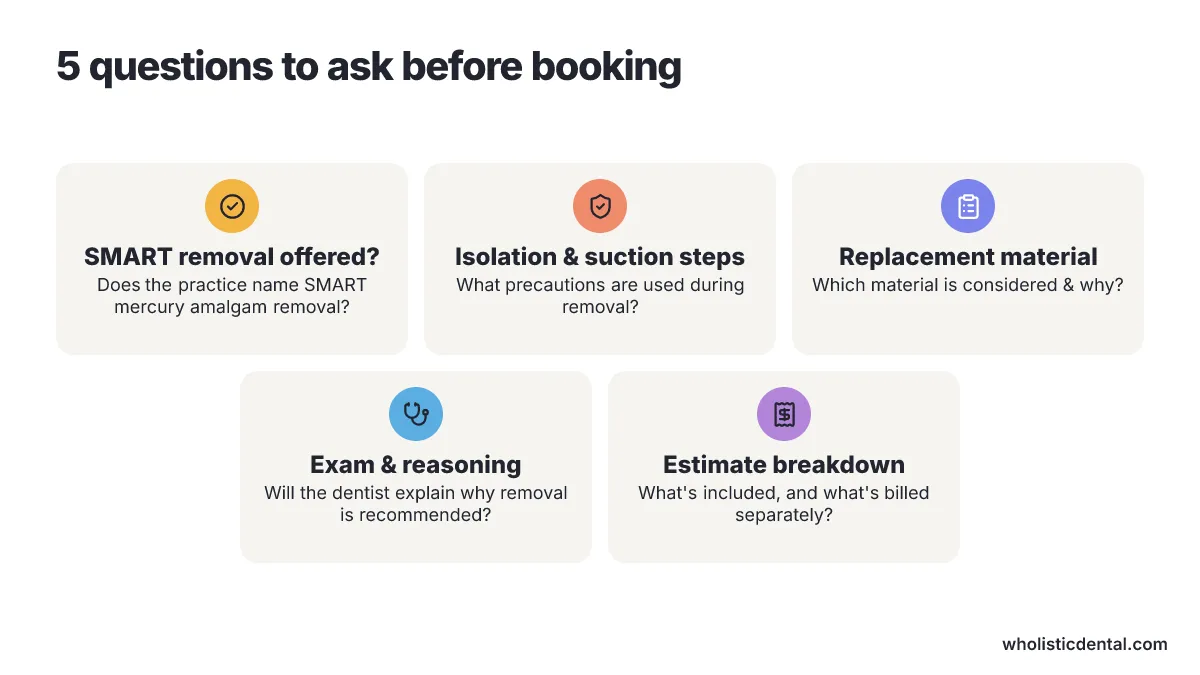
A useful phone call uses specific questions that an office can answer before treatment:
- Does the practice offer SMART mercury amalgam removal by name?
- What isolation and suction steps does the dentist use during removal?
- Which replacement material is being considered, and how will the dentist decide whether it suits the tooth?
- Will the dentist examine the filling and explain why removal is being recommended?
- What does the estimate include, and which parts of the visit could be priced separately?
The answers should distinguish a named service from a general promise to replace an old filling. A patient asking about mercury fillings who hears that composite is available can ask a follow-up about the removal steps; a patient who hears that a named protocol is offered can still ask what the office does during the appointment. Either way, record the answers before comparing estimates so that the same questions are being compared across practices.
How should you compare isolation, water spray and suction?
Compare the planned isolation, water spray and suction steps without treating an unverified research reference as a guarantee of safety. The linked rubber-dam research record and additional amalgam-removal research record remain available as references, but their study text could not be verified during this update. This comparison therefore does not rely on them for numerical exposure estimates, claims about the effect of rubber dams, or conclusions about clinical benefit.
Isolation remains a useful item on the procedure-comparison checklist, rather than a benefit established by those unverified records. The FDA's linked warning about temporary exposure during removal supports considering the procedure itself; it does not confirm that any local office follows a particular protocol.
A procedure checklist and a treatment decision answer different questions. A statement about isolation would need evidence explaining what was measured, under what conditions, and whether the result concerned exposure or patient health. Without that verified context, the presence of a research link should not be treated as proof that an intact filling should be removed or that a specific precaution guarantees safety.
Water spray and suction are also items to compare in a removal plan. The linked water-spray and suction research record could not be verified during this update, so this article does not use it to state airborne mercury measurements or predict a patient's exposure. Ask the dentist how the office manages vapor and particles during removal, and how the answer relates to the patient's specific treatment.
A useful explanation of water spray and suction should describe the planned appointment without promising an unverified exposure level. To use research as evidence, this comparison would need a readable source that identifies the setup, the measurements and the limits of the conclusion. Until that source is confirmed, the research reference is background to investigate, not evidence that a named practice achieves a particular result.
Does FDA guidance mean an intact filling should be removed?
An intact filling with no medical or dental reason for removal is the important exception to a removal-first approach. In 2020, the FDA advised certain higher-risk groups to avoid new amalgam fillings when possible and appropriate, but it did not recommend removing intact fillings unless medically necessary. A patient who is pregnant, nursing, arranging care for a child, or managing a neurologic or kidney condition can raise the FDA guidance at the exam and ask the dentist to explain the risks and benefits for that individual case.
Do policy announcements determine whether a filling needs removal?
Policy developments do not replace an individual dental assessment. On March 3, 2026, the WHO called for a global shift toward less-invasive oral health care alongside a transition away from mercury-containing amalgam. The guideline's emphasis on prevention and less-invasive cavity management is relevant to a patient weighing treatment, but it does not determine whether a particular existing filling should be removed.
The WHO guideline gives patients another subject to raise at an examination: whether prevention or less-invasive cavity management is appropriate for the tooth being assessed. It does not provide an individual diagnosis or a recommendation for a particular filling. Ask the dentist to explain how the condition of the tooth informs the proposed treatment before agreeing to removal or replacement.
Washington policy claims also need a readable primary record. The linked Washington Dental Commission meeting document was reachable, but its text could not be checked for the petition decision described in the supplied draft. This article therefore does not present that claimed decision or committee assignment as verified policy, a restriction on amalgam, or a recommendation to keep or remove an individual filling.
Coverage discussions also remained unsettled in the supplied 2026 materials. On July 22, 2026, HHS said CMS encouraged states to reconsider Medicaid amalgam coverage, but the announcement did not mandate a Washington coverage change.
On September 17, 2026, the Washington Health Care Authority opened rulemaking to remove amalgam from an improved fee under the Access to Baby and Child Dentistry program; that filing was not a final coverage change. Patients using Medicaid should ask their dental office or plan what applies to their own coverage rather than treating either announcement as confirmation that a service is covered.
How should you compare removal and replacement costs?
Cost questions need a specific estimate because the supplied local facts do not give a Greater Seattle price for mercury-free fillings or SMART removal. Ask whether the estimate covers the examination, any imaging the dentist recommends, the removal appointment, the replacement material, and any separate precautions or follow-up. A quoted price for composite replacement may not include the removal service or answer how the office manages the procedure.
The estimate is more useful when it separates the dentist's assessment from the procedure and restoration. Ask which items are included, which could be billed separately, and whether the quoted amount changes if the dentist recommends a different restoration after examining the tooth. The available local information does not list prices, so the office's written estimate is the basis for comparing costs.
A focused comparison call can then match the office to the patient's priority. Call Wholistic Dental Care when the priority is a practice that names SMART mercury amalgam removal and describes a biological dentistry approach. Call Harbour Pointe Family Dentistry when the priority is a local service page describing composite replacement, and ask directly whether SMART-specific precautions are used. The decision should rest on the answers the dentist gives about the patient's tooth and the planned procedure, not on treating "metal-free" and "SMART" as interchangeable terms.
Safety note: intact fillings and urgent symptoms
An intact filling is not automatically a reason for treatment: the FDA guidance cited above does not recommend removing existing amalgam fillings in good condition unless medically necessary. This comparison of local practices is not a diagnosis or evidence that removal is needed.
For a possible dental infection, difficulty breathing, speaking or swallowing requires emergency care, according to the NHS dental abscess guidance. In Mukilteo, seek local emergency medical help rather than waiting to compare routine removal appointments.
Comparing removal plans and replacement estimates
Begin by contacting the office whose stated service matches the concern that prompted the search. Ask what the first appointment involves, what the dentist needs to assess before recommending removal, and how the office will explain the removal steps and replacement material. Those answers give you a concrete basis for deciding whether to schedule an examination.
Bring a list of the fillings you are concerned about, any relevant medical guidance you have received, and your questions about procedure and cost. The dentist's examination should determine whether a filling needs treatment and what options fit the tooth. A clear estimate and explanation before treatment are the next practical requirements.
Frequently Asked Questions
Which Mukilteo dentist specifically lists SMART mercury amalgam removal?
Wholistic Dental Care is identified for that service in the supplied description, but this update did not independently verify a SMART listing or certification on its live homepage. The homepage supports a holistic/biological focus, not all the specific service and material claims in the supplied text. No claim of superior clinical safety follows from its inclusion in this comparison.
What should I ask before scheduling SMART amalgam removal in Mukilteo?
Ask Wholistic Dental Care to describe the appointment step by step, including what the exam reviews, what happens during drilling, and how the tooth is rebuilt. Ask what isolation and suction steps and safety gear are used, why removal is recommended, and how the replacement material is chosen. The supplied description associates the clinic with SMART removal, but the current protocol and credentials remain unverified here.
Should every silver filling be removed because it contains mercury?
No. The article advises asking whether the dentist thinks removal is appropriate and what clinical reasons support it. It also notes that the FDA says cutting out an old amalgam filling can temporarily increase mercury-vapor exposure. Those points make the decision and removal precautions separate questions; the article does not say every intact filling should be removed or that one plan fits everyone.
What composite options does Wholistic Dental Care offer after amalgam removal?
The supplied description mentions material compatibility screening and metal-free options, but this update did not verify their current availability or clinical benefit. No composite brand, cost or standard restoration package is established by the checked homepage. The dentist can assess the tooth and explain whether a specific composite suits the bite and health priorities. Ask what material is proposed and what the estimate includes, since the article says those details are not published.
Related reading
Sources
- Harbour Pointe Family Dentistry
- FDA: Information for Patients About Dental Amalgam Fillings
- FDA: Recommendations for Certain High-Risk Groups Regarding Mercury-Containing Dental Amalgam
- Dental Materials: Mercury Levels in Plasma and Urine After Removal of All Amalgam Restorations
- European Journal of Oral Sciences: Effect of Rubber Dam on Mercury Exposure During Amalgam Removal
- Journal of Occupational Medicine and Toxicology: Mercury Vapour Exposure During Dental Student Training in Amalgam Removal